CTF878 Clamp On Gas Meter
- Only flowmeter worldwide to measure low pressure flows (<5 bar) Worldwide support/installation by experienced engineers
- No Downtime - minimal installation costs Wide range of applications including natural gas, corrosive/toxic gases, low pressure
- Correlation Tag Technology Unique technology providing accuracies of +/-1 to 2% of rate. AGA compliant
- Sales, Rental & Installation
Overview
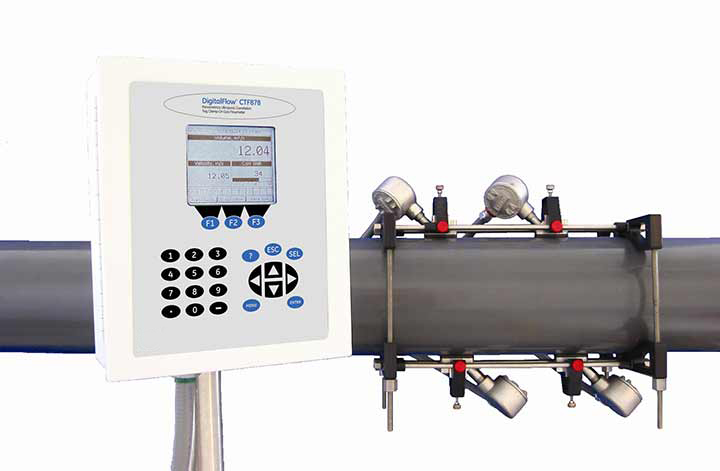
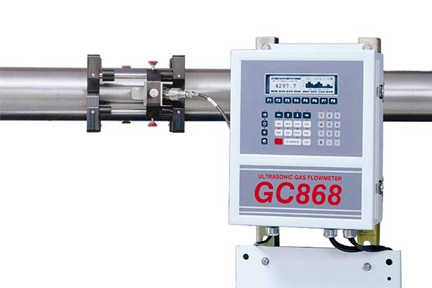
The DigitalFlow CTF878 Correlation Tag Clamp-on Gas Ultrasonic Flowmeter is suitable for metal pipes and for pressure as low as atmospheric. It is non-invasive, has no wetted parts or moving parts. There is therefore no process down time or significant installation costs for this clamp on technology.
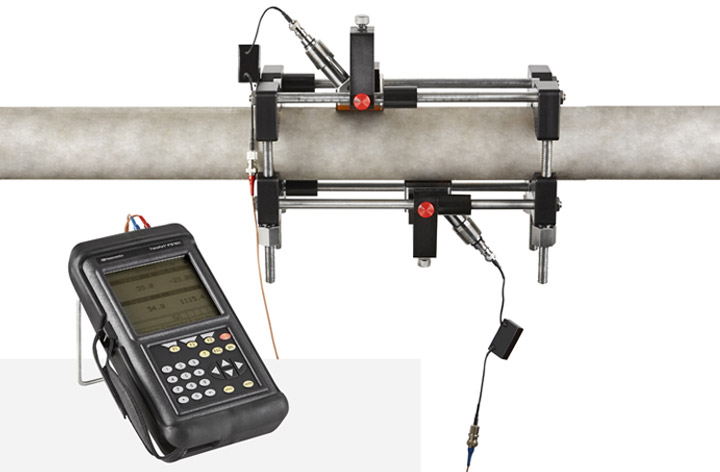
The CTF878 uses a new technology called correlation tag, to determine the flow rate of gases. This is like no other clamp on gas flowmeters. The CTF878 flow meter is supplied with two pairs of ultrasonic transducers - the first measure the upstream disturbance, and the second (situated downstream) record the downstream disturbance. The flow meter constantly samples these traces and correlates the two traces. When the flow meter recognises that the same disturbance pattern has travelled along the pipe, it is possible to measure the velocity. This is done constantly every second. Each pair of transducers includes a transmitter sending ultrasound in a continuous wave mode through the fluid to the receiver, forming an upstream and downstream interrogation path. The continuous wave signal is modulated by turbulence and local density variations that are characteristic of a moving gas.
In the past, a restricting factor in gas measurement has been the signal strength of transducers: having to send an ultrasonic signal through the metal pipe wall, through the gas, and then back through the pipe wall again. New clamp-on gas transducers produce signals that are five to ten times more powerful than signals of traditional ultrasonic transducers. This new technology produces clean, strong signals with marginal background noise.
Specifications assume a fully developed flow profile (typically 20 diameters upstream and 10 diameters downstream of straight pipe run).
Manufactured by: Panametrics
Model: CTF878 Clamp On Gas Meter
Services offered for this product
- Sales
- Rental
- Installation
- Calibration
- Maintenance
- IoT Cloud Compatible
Applications
Natural gas
Compressed air
Low Pressure Applications
Fuel gases
Corrosive gases
Toxic gases
High-purity gases
Air separation gases
Speciality gases
Specification
| Operation and performance | |
| Fluid types | All acoustically conductive gases. Minimum gas density: 0.074 lb/ft3 (1.2 kg/m3). Gas not be wet or saturated with moisture. |
| Pipe sizes | 2 to 36 in. NB ANSI (50 to 900 mm DN) |
| Pipe materials | Most metals and plastics. No lined pipes |
| Flow accuracy (velocity) | ±2% of reading |
| Repeatability | ±0.2% to 0.6% |
| Range (bi-directional) | ±10 to ±200 ft/s (2 to 2.5 in./50 to 60 mm pipe size) ±7 to ±200 ft/s (3 to 3.5 in./80 mm to 90 mm pipe size) ±5 to ±200 ft/s (4 to 5 in./100 to 125 mm pipe size) ±3.5 to ±200 ft/s (6 to 36 in. or 150 to 900 mm pipe size) |
| Gas type and minimum pressure | Dry air, oxygen, nitrogen or argon: ≥14.5 psia (1 bara) Sweet natural gas: ≥25 psia (1.7 bara) |
| Measurement parameters | Velocity, actual and standard (ideal gas) volumetric flow, and totalized flow |
| Electronics | |
| Flow measurement | Correlation tag technique |
| Enclosures |
|
| Dimensions (h x w x d) | 362 x 290 x 130 mm (14.24 x 11.4 x 5.12 in) |
| Weight | 5 kg (11 lb) |
| Channel | Single channel |
| Display | 240 x 200 pixel backlit LCD graphic display |
| Keypad | 24-key rubberized tactile membrane |
| Power supply | 85 to 264 VAC, 50/60 Hz (standard) |
| Operating temperature | –10 to 55°C (14 to 131°F) |
| Storage temperature | –40 to 70°C (–40 to 158°F) |
| Standard inputs/outputs | Two 0/4 to 20 mA isolated outputs, 550 Ω maximum load |
| Optional inputs/outputs | There are six additional slots available for any combination of the following I/O boards:
|
| Digital interfaces | Standard: RS232 Optional: RS485 (multiuser) |
| Data logging | Memory capacity (linear and/or circular type) to log over 6900 flow data points |
| Display functions | Graphic display shows flow in numerical or graphic format |
| European compliance |
|