Open Channel Flowmeters

For the majority of non-contact open channel flow meter applications, the fixed or permanent open channel flow meter or area velocity meter is required to continuously monitor flows for licensing, monitoring, MCERTS, process measurements and IPPC permits.

RS Hydro have an extensive range of small channel flowmeters for both temporary and permanent installation. Measurement technologies include doppler sensor, submerged probe, bubbler and area velocity flow                   measurement. Whatever the requirements of your small channel                        application, RS Hydro can supply the equipment and expertise                             to provide the total open channel flow meter solution.
Recent advances in pulse doppler technology have set new standards for flow measurement in wide channels. Versatility, accuracy and ease of maintenance makes doppler flow meters the best choice for open channel flow measurment in large channels.
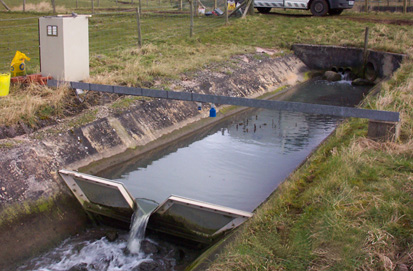
For permanent installation flow measurement of effluent and discharge channels a gauging structure such as a v-notch, weir or flume is needed. These must be manufactured and installed correctly or the accuracy of measurement will be diminished. RS Hydro provide a total solution, from open channel flow meters to gauging structures.

Regularly maintained non-contact open channel flow meters, properly installed in an ideal location, will give inaccurate discharge flow measurements if the operator uses poor measuring techniques. Head measurement is very important. With frequent occurrence, flow monitoring installations are often not compatible with the relationship that actually exists between the known head and discharge relationship. As such, operators should make sure that calibration curves or tables match the flow measurement devices that are being used.

Although chart recorders, staff gauges and floats are often used to provide an instantaneous head and hence flow measurement, today's technology allows continuous online flow measurements to be made with optimum accuracy. There are many manufacturers that produce flow and level measurement devices that broadly fit into the following categories:

  • non-contact ultrasonic;
  • non-contact radar;
  • hydrostatic.

Ultrasonic Non-Contact Flow Meter

Non-contact ultrasonic sensors emit acoustic pulses and receive an echo from the material being measured. The sensor is connected to a transceiver that calculates level by processing the time between the original signal and its echo. For most level measurement applications in the environmental industries, ultrasonic technology is the best choice. Because it’s non-contacting, it avoids the corrosion, material build-up, and general wear and tear associated with contacting devices. Higher maintenance costs and repairs associated with contacting devices can easily exceed any initial savings.

Most industries now pay for the volume of water consumed or materials discharged into the environment. In many jurisdictions, environmental regulations now require strict reporting of all discharges, with accompanying fines or penalties. When plants implement steps to reduce pollution and discharges, they need an effective way to measure their progress. At one time, the only alternative was magmeters which are expensive and not always practical for many open channel installations.

Today, accurate measurement of river and stream flow monitoring is simple and cost-effective with an ultrasonic open channel flowmeter. Combined with an ultrasonic transducer, it monitors flow and provides data you can use for rainfall/storm water studies, inflow/ infiltration studies and sewer system evaluations.

Good examples of open channel flowmeters are the OCM3 and HydroRanger Series from Milltronics which provide good accuracy and reliability.

Open Channel Flow Meter: Radar

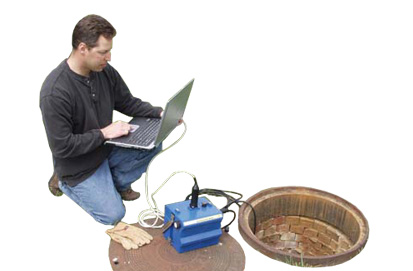
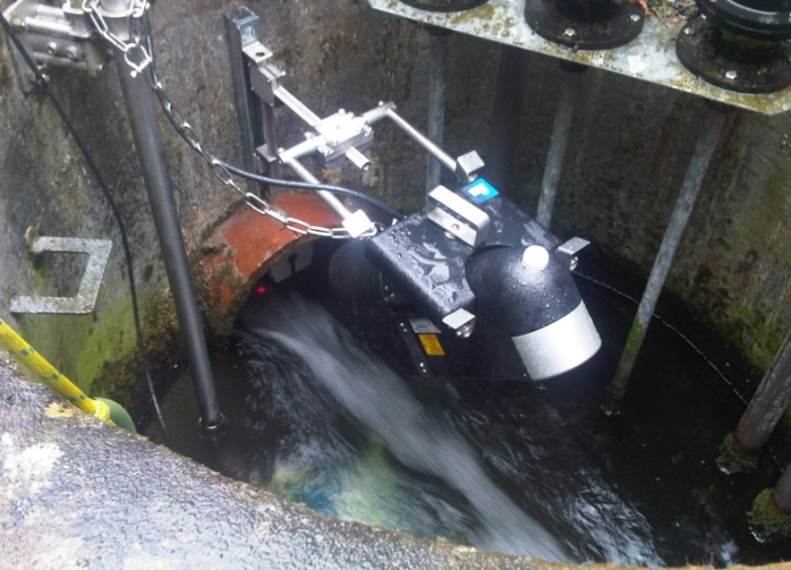
Open Channel Flow Meter Installation with compound v-notch being installedDue to the shorter wavelengths of ultrasound, radar technology has not been used in the same way as other non-contact flowmeters. However, one device, known as Flo-Dar has been used to measure flow in open channels. The Flo-dar flowmeter is a non-contact radar velocity/area open channel flow monitor. This radar sensor can be combined with a stationary monitor unit or with a low power portable battery operated flow logger. The advanced radar velocity sensing technology combined with ultrasonic pulse echo level sensing remotely measures flow in existing sewers without pipe modifications. The sensor is positioned above the flow, thereby eliminating fouling and other problems associated with traditional flowmeters where the sensor is immersed in the flow. The Flo-dar flowmeter provides the user with flow measurements under a wide range of flows and site conditions such as:

  • Shallow flow
  • High velocities
  • Flows with high solid contents
  • High temperature flows
  • Caustic flows
  • Large sewers

Other examples of innovative technology that can actually interpret a velocity profile of a cross-section of water as well as measure the flow acurately is the Nivus PCM and OCM Pro. This device interprets the velocity of the over-head flow using advanced ultrasonic correlation methods.

Advantages

  • Personnel have no contact with the flow
  • Easy installation
  • One-time entry into confined space for installation/removal
  • Maintenance caused by immersed sensor is eliminated
  • No site calibration required
  • Field replaceable and interchangeable sensors and monitors

Hydrostatic Sensors / Pressure Sensors

A third way of determining head is by utilising low-range hydrostatic or water level sensors, in stilling wells, to establish the upstream head. However, such devices ordinarily produce a 4-20mA output of level not flow. This level has then to be interpreted by a further device or plotted on a calibrated stage-discharge curve to obtain a true flow. It should be stated that pressure transmitters are prone to drift, movement and blocking. Other devices include bubbler systems, or angular transducers sensing shaft rotation on a float-driven system. These types of system are perhaps best suited to the transmission of data via satellite or microwave, providing a central control location with current water stage information, as they utilise small amounts of power.. Remote sites are very well suited to being powered by batteries which are charged through small solar cells. However, vandalism of the solar panels can be a problem because they must be exposed. Concealing solar panels in some way (such as in the top of a tree) can help.